Lorier · Hyperion
Hyperion
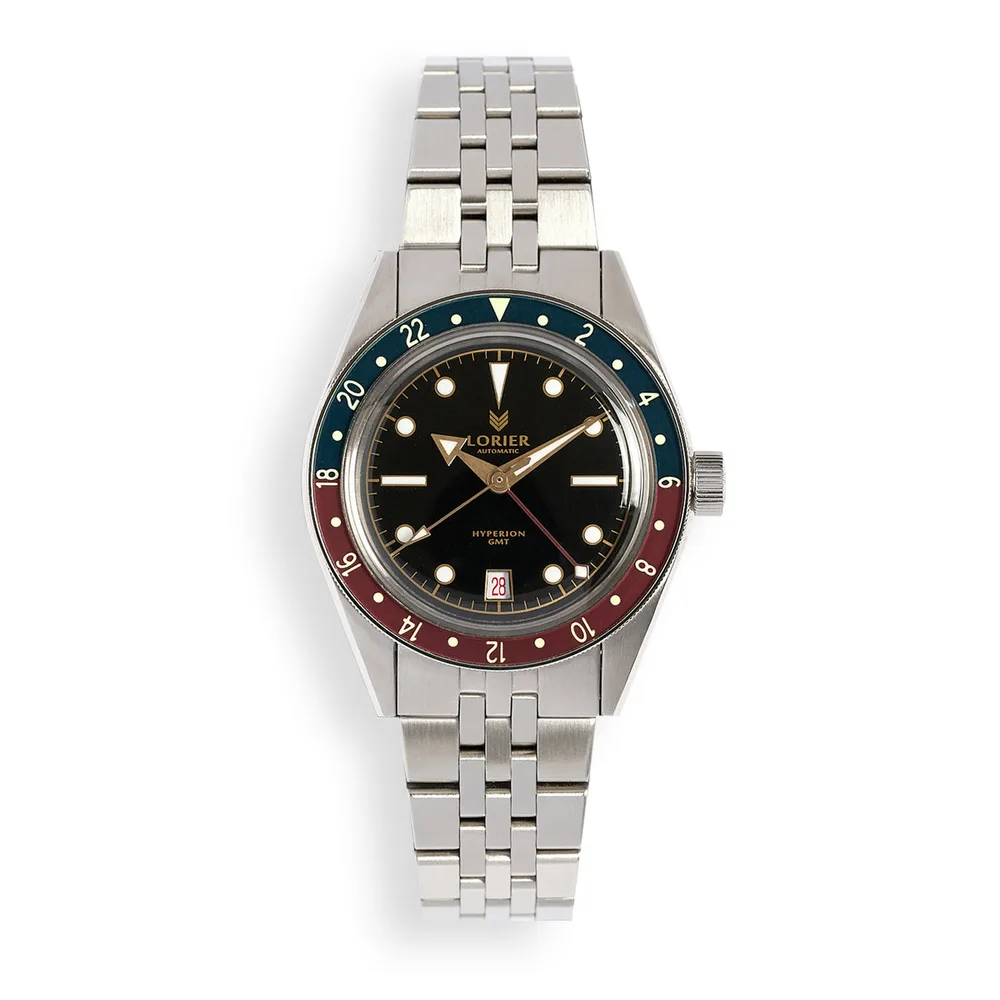
The Lorier Hyperion SII is a vintage-inspired GMT from American microbrand Lorier, housed in a slim 39mm 316L steel case topped with a domed Hesalite crystal and an Air Force blue/burgundy 'Pepsi' bezel. Powered by the Miyota 9075 flyer GMT, it lets you set the local hour hand independently while seconds keep running — all for $699.
Compare with anotherCase
Water res.
Thick
Lug-to-lug
Overview
| Brand | Lorier |
| Collection | Hyperion |
| Category | GMT |
| Released | 2024 |
| Price guide | Mid-range · $600–900 |
Full specification
Specs
Case & dial
| Diameter | 39 mm |
| Lug-to-lug | 46 mm |
| Thickness | 12.7 mm |
| Lug width | 20 mm |
| Water resistance | 100 m |
| Crystal | domed Hesalite |
| Case material | stainless steel |
| Bezel | 24-click bidirectional, Air Force blue and burgundy Hesalite insert |
| Case back | solid |
Movement & furniture
| Type | Automatic |
| Caliber | Miyota 9075 → |
| Functions | GMT (24h hand), Date |
| Power reserve | 42 h |
| Jewels | 24 |
| Lume | Super-LumiNova BGW9 (dial indices and main hands), C3 (GMT hand and bezel) |
| Strap / bracelet | steel bracelet |
Bottom line
A genuinely compelling sub-$1,000 flyer-GMT with period-correct vintage character, the Hyperion SII is hard to beat for the money — provided you accept domed Hesalite over sapphire and 100m rather than diver-grade water resistance.
Highlights
- True flyer GMT — independent local hour hand
- Slim 39mm / 46mm lug-to-lug
- Domed Hesalite crystal
- Vintage 'Pepsi' Air Force blue & burgundy bezel
- Roulette datewheel
Who it's for
Travellers and GMT enthusiasts who want a slim, vintage-flavoured 39mm case that wears comfortably on small-to-medium wrists (up to roughly 7 inches), and who appreciate the warm optical character of Hesalite and the convenience of a flyer GMT hand. Good fit for those priced out of the Tudor Black Bay GMT who don't want to compromise on aesthetic seriousness.
Who should skip it
Skip it if you need sapphire crystal, water resistance beyond 100m, or guaranteed in-stock availability — the Hyperion sells out quickly and restocks on Lorier's own schedule.
Before you buy
- Two generations exist: SII (Miyota 9075, 46mm L2L, Epsilon bracelet) vs. original (Soprod C125, 47mm L2L) — confirm which you're buying secondhand
- Hesalite scratches easily; Polywatch is included but factor in periodic polishing
- Two SII variants: standard black dial (~$699) and Skyward edition (~$599) — verify which suits you
- Stock frequently exhausted; check lorierwatches.com for restock timing
FAQ
Is the Hyperion automatic or quartz?
The Hyperion is automatic. The Miyota 9075 winds itself from the motion of your wrist, so it needs no battery. A full wind holds roughly 42 hours, so it keeps running overnight off the wrist; left longer it stops and restarts once you wear or hand-wind it.
What movement does the Hyperion use?
The Hyperion is powered by the Miyota 9075 from Miyota, an automatic caliber with 24 jewels, a 42-hour power reserve, and a 28,800 bph beat rate. Being automatic, it winds from the motion of your wrist and needs no battery.
Does the Hyperion have a date?
Yes — the Hyperion has a date display on the dial. The date advances automatically as the movement runs, so the current day of the month is always visible at a glance, and you can set it from the crown after the watch has been left to stop.
How water resistant is the Hyperion?
The Hyperion is rated to 100 m. That covers swimming and snorkelling, though hot water and direct high-pressure water are best avoided, and it is not intended for scuba diving. Whatever the rating, avoid operating the crown or pushers underwater, and have the gaskets checked periodically to keep it reliable.
How big does the Hyperion wear?
At 39 mm across with a 46 mm lug-to-lug and 12.7 mm thick, the Hyperion wears as a versatile mid-size watch. Lug-to-lug is the measurement that really decides fit, since it sets how far the case spans the wrist — 46 mm suits most wrists, and smaller wrists especially should check that figure.
What makes this a 'true' or 'flyer' GMT rather than a caller GMT?
The Miyota 9075 lets you advance the local (12-hour) hand in one-hour steps while the movement continues running, so you never lose seconds when crossing time zones — a caller GMT requires stopping the movement to adjust the hour hand.
Why does Lorier use Hesalite instead of sapphire?
Lorier chose Hesalite for its period-correct vintage look, warm optical clarity, and repairability — light scratches can be buffed out with the included Polywatch tube, whereas sapphire is much harder and not comparable for simple at-home Polywatch-style buffing.
How does the Hyperion SII compare to the original Hyperion?
The SII replaces the Swiss Soprod C125 with the Miyota 9075 flyer GMT, trims the lug-to-lug from 47mm to 46mm, adds the new 5-link Epsilon bracelet, and refines hand legibility — at the cost of a modest increase in overall case thickness.
Compare with
Alternatives
Spotted something wrong? Report a correction →