Lorier · Neptune
Neptune
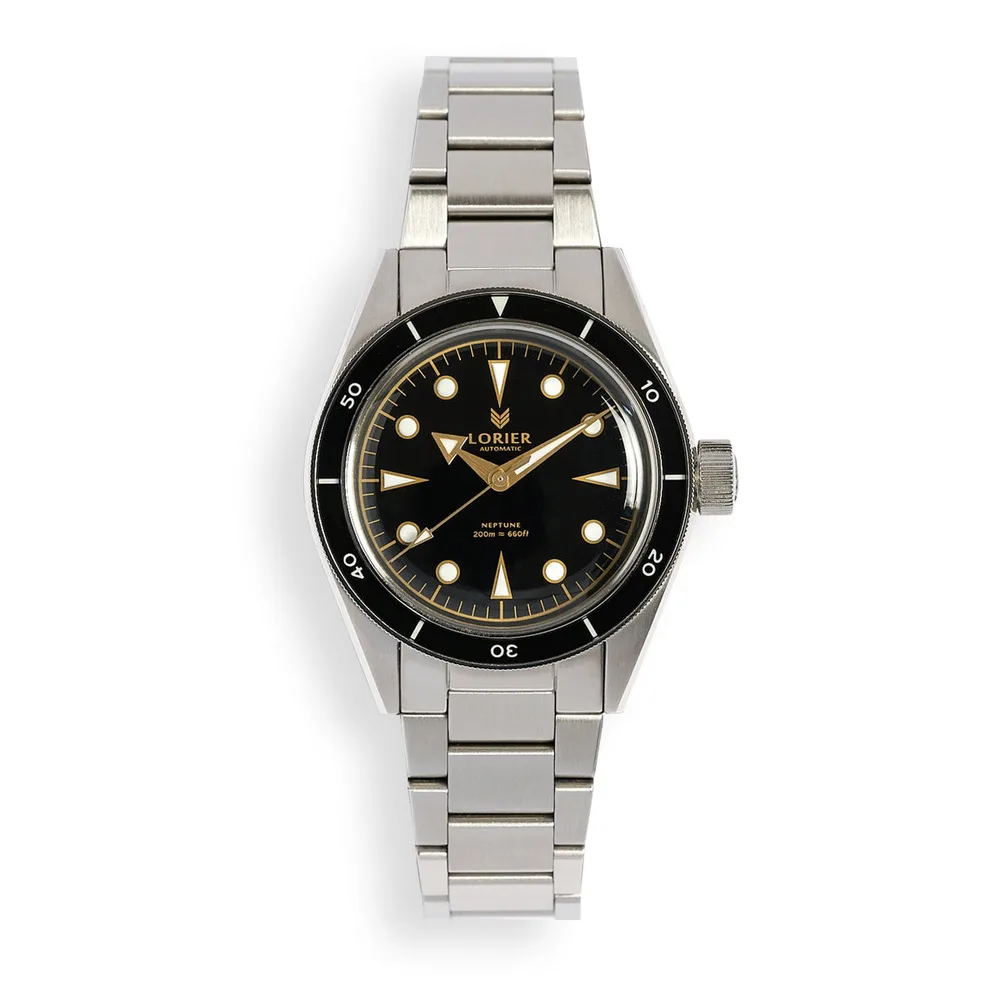
The Lorier Neptune Series IV is a New York microbrand's vintage-inspired automatic diver, pairing a 39mm 316L stainless steel case with a domed Hesalite crystal, 120-click unidirectional bezel, and 200m water resistance. It draws on 1950s–70s diving references with gilt broad-arrow hands, oversized lume plots, and a period-correct luminous acrylic bezel insert.
Compare with anotherCase
Water res.
Thick
Lug-to-lug
Overview
| Brand | Lorier |
| Collection | Neptune |
| Category | Dive |
| Released | 2023 |
| Price guide | Entry-level · Under $600 |
Full specification
Specs
Case & dial
| Diameter | 39 mm |
| Lug-to-lug | 46 mm |
| Thickness | 12.7 mm |
| Lug width | 20 mm |
| Water resistance | 200 m |
| Crystal | hesalite domed acrylic |
| Case material | stainless steel |
| Bezel | unidirectional dive, 120-click, luminous acrylic insert |
| Case back | solid |
Movement & furniture
| Type | Automatic |
| Caliber | Miyota 90S5 → |
| Power reserve | 42 h |
| Jewels | 24 |
| Lume | BGW9 Super-LumiNova |
| Strap / bracelet | stainless steel flat-link bracelet |
Bottom line
A convincingly period-correct microbrand diver that packs genuine design conviction and impressive finish quality into the $599 tier, though the Hesalite crystal and small-batch supply cadence are real trade-offs buyers should weigh.
Highlights
- Domed Hesalite crystal (polishable, period-correct)
- Luminous acrylic bezel insert
- Compact 39mm / 46mm L2L
- 200m + screw-down crown
- Miyota 90S5 with hacking and hand-winding
Who it's for
Buyers with 6.5–7.5-inch wrists who want a historically-proportioned no-date diver with 1950s-era aesthetics — gilt hands, oversized lume plots, a domed crystal — without vintage-market uncertainty or a steep entry price. Also suits microbrand enthusiasts who appreciate deliberate design choices and are comfortable with small-batch availability.
Who should skip it
Skip it if you prefer a scratch-resistant sapphire crystal, need reliable in-stock availability, or want a date complication on the same no-date movement.
Before you buy
- Collection listed as 'returning mid-2026' — confirm live stock before ordering
- Date and no-date variants use different movements (Miyota 9015 vs 90S5) — verify variant at checkout
- Hesalite scratches more readily than sapphire — factor in periodic PolyWatch polishing
- Sold in limited batches that sell out quickly; secondary-market prices can vary
FAQ
Is the Neptune automatic or quartz?
The Neptune is automatic. The Miyota 90S5 winds itself from the motion of your wrist, so it needs no battery. A full wind holds roughly 42 hours, so it keeps running overnight off the wrist; left longer it stops and restarts once you wear or hand-wind it.
What movement does the Neptune use?
The Neptune is powered by the Miyota 90S5 from Miyota, an automatic caliber with 24 jewels, a 42-hour power reserve, and a 28,800 bph beat rate. Being automatic, it winds from the motion of your wrist and needs no battery.
How water resistant is the Neptune?
The Neptune is rated to 200 m. That is true dive territory: fine for swimming, snorkelling and recreational scuba diving, as well as all daily wear. Whatever the rating, avoid operating the crown or pushers underwater, and have the gaskets checked periodically to keep it reliable.
How big does the Neptune wear?
At 39 mm across with a 46 mm lug-to-lug and 12.7 mm thick, the Neptune wears as a versatile mid-size watch. Lug-to-lug is the measurement that really decides fit, since it sets how far the case spans the wrist — 46 mm suits most wrists, and smaller wrists especially should check that figure.
How does the Neptune SIV compare to a Seiko SPB or Orient Kamasu at similar money?
The Neptune prioritises vintage aesthetics — domed Hesalite, gilt details, luminous acrylic bezel — over the sapphire crystals and in-house movements those alternatives offer; it wins on period character and bracelet finish but concedes scratch-resistance and constant stock availability.
Is the Hesalite crystal a compromise or a deliberate design choice?
Deliberate — Lorier cites better optical depth, impact resistance, and the ability to polish out scratches as advantages over sapphire for a vintage-inspired watch, matching how 1950s–70s divers were actually built.
Are earlier Neptune series worth buying secondhand?
Series III uses the same Miyota 90S5 and is visually similar but has slightly longer lugs (≈47mm vs 46mm) and no luminous bezel insert; earlier series used Seiko NH-series movements before Lorier's 2020 switch to Miyota 9-series calibers.
Compare with
Alternatives
Spotted something wrong? Report a correction →